









Design
October 2026
Dear Designer, the Stuff Nobody Says Out Loud
WRITTEN BY
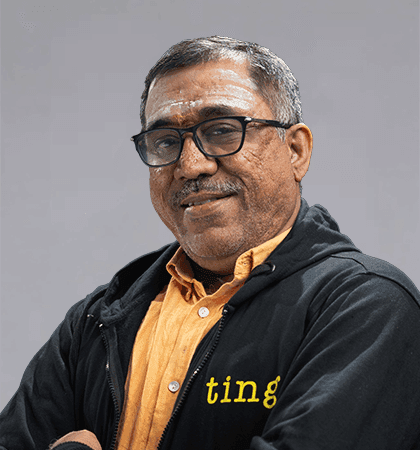
Vasudevan
Senior Creative Director

I started designing when a missing font at the printer could ruin your whole week. Today a machine makes a decent poster before my filter coffee cools down. Somewhere between those two, I picked up things nobody mentions in a portfolio review or a software tutorial. This is that list, for designers starting out now. The tools will keep getting faster and some jobs will shrink. The designers who get left behind won't be the ones who don't know AI. They'll be the ones who let it do their thinking. Use it to train your eye, test your ideas and learn faster than my generation ever could, but keep the judgement for yourself. Learn typography like a language. Know the people you design for. Be decent to the printer, the junior and the client. And keep some design in your life that nobody is paying for.
I am a half-engineer who worked in software for a while, and then walked into design and advertising. My professors would call it a detour. I call it the long way to the right place.
That was over 2 decades ago. Since then I've sat through more reviews than I can count, lost a few arguments I was right about and won a few I was wrong about. I've watched the tools change under my hands more times than I've changed phones. Today I'm Senior Creative Director at ting. After office I write Tamil poetry and stories. It's the one place where I'm both the client and the designer, and I'm still a difficult client.
Every time a junior joins the team, I notice two things. They're far sharper with software than I was at their age. They're also far more anxious. Nobody sits them down and tells them the stuff that actually matters, the stuff you usually learn only after a few bad nights and one or two good mentors. So consider this my attempt. It's the conversation we should have over chai after the meeting but did not.
I learnt design the slow way. You don't have to
When I started, files went to the press on CDs and a layout became film before it became paper. If the printer didn't have your font, your lovely headline came back set in something else, and you found out only when the proof arrived. Tamil typing meant juggling font encodings that refused to talk to each other. A Tamil headline that looked perfect on your screen could turn into boxes on somebody else's. I stood next to a running press at an odd hour while the operator told me, very politely, "Sir, colour konjam dull-aa varudhu," and I had to decide on the spot whether the problem was my file or his ink mix.
Print design taught me patience because mistakes were expensive. You can't undo fifty thousand leaflets. You checked, you checked again, and then you asked someone else to check.
Then came websites, then Facebook pages, then Instagram, and social media design became a full-time job of its own. The square became a portrait, the portrait became a Reel, and a brand that once released one campaign a quarter now wanted something every day. During a live match, sometimes every hour.
Now I type two lines and a machine gives me four decent-looking visuals in under a minute.
Here's what nobody tells you about all this. The tools changed every few years. The things that made the work good didn't change at all. Knowing who you're talking to. Knowing what you want them to feel. Knowing when a letter is sitting too close to its neighbour. I learnt those slowly, through expensive mistakes. You can learn them much faster now, if you use the tools in the right way and point your mind in the right direction.
The tools changed every few years. What made the work good never did. Learn that part first, and learn it faster than we did.
So, will the machines take your job?
Let me not dodge this one.
Some jobs will go. Some already have. If your work is resizing one master creative into forty formats, or making the fifteenth version of a sale post, a tool can do that cheaper and faster, and clients know it. The World Economic Forum's Future of Jobs Report 2025 surveyed over a thousand employers, and 40% of them said they expect to cut staff where AI can automate tasks. The same report placed graphic designers just outside its list of the ten fastest-declining roles, which is a first for that report. I'm not saying this to scare you. I'm saying it because somebody at a college fest is probably telling you "creativity can never be replaced", and I'd rather you hear the honest version from someone who has been around.
Read the report: https://www.weforum.org/publications/the-future-of-jobs-report-2025/digest/
The same report also expects more jobs to be created than lost by 2030. So the real question isn't whether humans will be left behind, rather which humans will be left behind.
The pace itself is strange. Software changes between two reviews. Clients change their thinking over years. And the brief? The brief still says "make it premium", same as it did in 2003. Premium, I've learnt, is a place everybody wants to go and nobody can find on a map.
The designers I worry about are not the ones who don't know AI yet. They'll learn it in a weekend. I worry about the ones who can produce a finished-looking visual but can't tell you why it works. When everyone can make something that looks good, looking good stops being your job. Knowing what's right for this brand, this audience and this moment becomes your job. A client can't get that with a monthly subscription.
Treat AI like a gym, not a lift
A lift takes you to the tenth floor and your legs are exactly as strong as they were on the ground floor. A gym is harder, and you walk out changed.
Most people use AI like a lift. Type a prompt, take the output, move on. Do that for two years and you'll be exactly as good as you were on day one, just quicker. That's the laziness trap, and it's a very comfortable trap. Here's how I'd use it if I were 24 again.
Make it argue with you. Show it your layout and ask what's weak. Then argue back. Half the time it'll be wrong, and working out why it's wrong will teach you more than any tutorial.
Generate fifty, then defend one. Let the tool throw fifty options at you. Your job is to pick one and write two lines on why the other forty-nine don't work for this brand. That's art direction, and it's the muscle clients will pay you for later.
Rebuild what stops you. When a generated image makes you look twice, don't just download it. Rebuild the composition by hand. Where is the light coming from? Why does your eye go there first? Take the lesson, leave the pixels.
Ask the questions you were scared to ask a senior. Why does this serif feel old-fashioned? Why did that famous rebrand get trolled? Then verify, because it will sometimes make things up with a very straight face. Checking is part of the learning.
Give it the boring work, and spend the saved time on the hard work. Cut-outs, extensions, first-round resizes, go ahead. But if the tool saves you two hours, those two hours belong to the idea. Not scrolling.
The rule I follow is simple. The day you can't explain your own work without saying "AI gave it", you've stopped being a designer and become a courier service for software.
There's a Kural I keep going back to.
Learn what's worth learning, learn it without gaps, and then live up to it. Valluvar wasn't thinking about image generators when he wrote that. It still fits better than most things I've read about AI.
Outsource the labour to the machine, never the judgement. If you can't explain your work without the tool, it isn't yours yet.
Typography is where you get found out
You can fake a lot in this business. You can't fake typography for long.
A strong image hides many sins. Type has nowhere to hide. Kerning, line breaks, the size of the price in a retail ad, the way a vernacular headline sits next to an English sub-head, it all shows. And in my experience AI is still clumsy with type, especially Indian scripts. That's your opening. Take it.
Learn typography like a language, not a style. Read the words before you arrange them. A headline that says "Flat 50% off" and a condolence message cannot be set the same way, even if the brand guide gives you only one font.
I write Tamil poetry in classical metres, where one syllable too many breaks the whole line and you have to hear it to know. Type works like that for me now. Sometimes I know a line of text is wrong before I can explain why. That instinct didn't come from talent. It came from twenty-odd years of looking closely and being told I was wrong.
Print design is still the best teacher for this. Paper doesn't forgive. A 6-point disclaimer that looked fine at 200% zoom is unreadable on a pack in someone's hand. Print your work once in a while, even if it's only going on Instagram. Hold it at arm's length and see what your eye reads first.
Social media design has its own brutal test. A thumb scrolling at full speed, on a budget phone, with the brightness turned down to save battery. If your message doesn't land there, in that one second, it doesn't matter how nice it looked on your big monitor.
Try this small exercise this week. Set one paragraph three ways and print all three. Show them to your amma or the security uncle downstairs and ask what they read first. You'll learn more from their confused expressions than from a paid masterclass.
And please respect the script you're setting, whether it's Tamil, Hindi or Malayalam. Those letters are not English wearing a veshti. They have their own shapes and their own spacing logic. If you don't know the language, sit with someone who does before the design is locked, not after the client points it out.
Be a better ad person, and a better human while you're at it
This is the section nobody puts in a design course.
Advertising is a business. Some days the job is to make the offer bigger and send the file on time. Not every piece is your Cannes moment, and that's perfectly alright. Being reliable is a skill. So is hearing feedback without treating it as a court verdict on your talent. The client who says "make the logo bigger" is usually trying to tell you something else. Find out what it is.
Learn how money works. What was the scope? How many rounds did we agree to? What does this campaign actually have to sell? The designer who understands the business gets called into the room where decisions happen. The one who only understands the software gets the files after the decisions are made.
Learn to say "yes, and here's what it'll take" instead of a flat yes or a flat no. It's the most useful sentence in this industry. In advertising, nights and weekends come with the territory, and that's fine. But "passion" is a poor staffing plan, and burnout is not a medal.
And be decent. To the printer who stays back for your job. To the junior who is scared to ask. To the copywriter whose line you're about to make smaller. Credit people by name. Don't pass off a reference as your idea, and don't pass off a generated image as your own hand. This industry is smaller than you think, and people remember who was kind to them at 11 pm.
Now a word for people at my level, because this isn't only the juniors' homework. We can't ask for thinkers and then hand juniors nothing but resizing and corrections. If AI takes away the grunt work many of us learnt through, we have to build new ways to teach. Take them to the briefing. Show them why a route died. Let them present, even if they fumble. "Be curious" is easy to say when your own calendar has room. Seniors have to make that room. I'm working on it too.
People forget your best layout. They remember who was kind to them at 11 pm on a deadline night. Be that designer.
Keep one design life that nobody pays for
Design has been a lot of things to me over the years. A job, obviously. A way of looking at the world. Something I do on a Sunday for no reason at all. The mistake I see young designers make is letting the job swallow everything else.
When everything you make has to become content, or a portfolio piece, or a side hustle, you slowly stop making things for yourself. And the work that's only yours is where your taste gets built. Poetry does that for me. No client, no deadline, nobody asking me to make it premium. I can spend a whole evening on one word and nobody complains. That freedom walks back into my office work in ways I can't measure.
So keep something. A sketchbook, lettering practice, photos of old shop boards in your area. You don't owe every sketch a launch strategy.
My design philosophy at this point is fairly simple. Pay attention to how your choices land on another person. Can they read it? Does it help them decide? That habit follows you out of the office. You start noticing the confusing bus board, the badly signed hospital corridor, the form your grandmother can't fill. That, for me, is design as a way of life. Not a mood board. Attention.
If you want somewhere to start, here's a one-month challenge. Take one small idea and make it work as print design and as social media design. Fix its typography until you can explain every choice out loud. Use AI for one part of it and note honestly what it saved and what it got wrong. Then show it to someone outside the industry and keep quiet while they react. Put that whole story in your portfolio, not only the final image.
After close to 23 years, I still learn something most weeks. If you join my team and teach me something I didn't know, that's a good day for both of us. Bring your questions. I might not have the right answers but I promise better answers than "make it premium".
about the author
Vasudevan
Senior Creative Director