










Product Photography
October 2026
You Can Direct a Model. But Can You Direct a Product?
WRITTEN BY

Sumit Chavan
Associate Creative Director – Studios

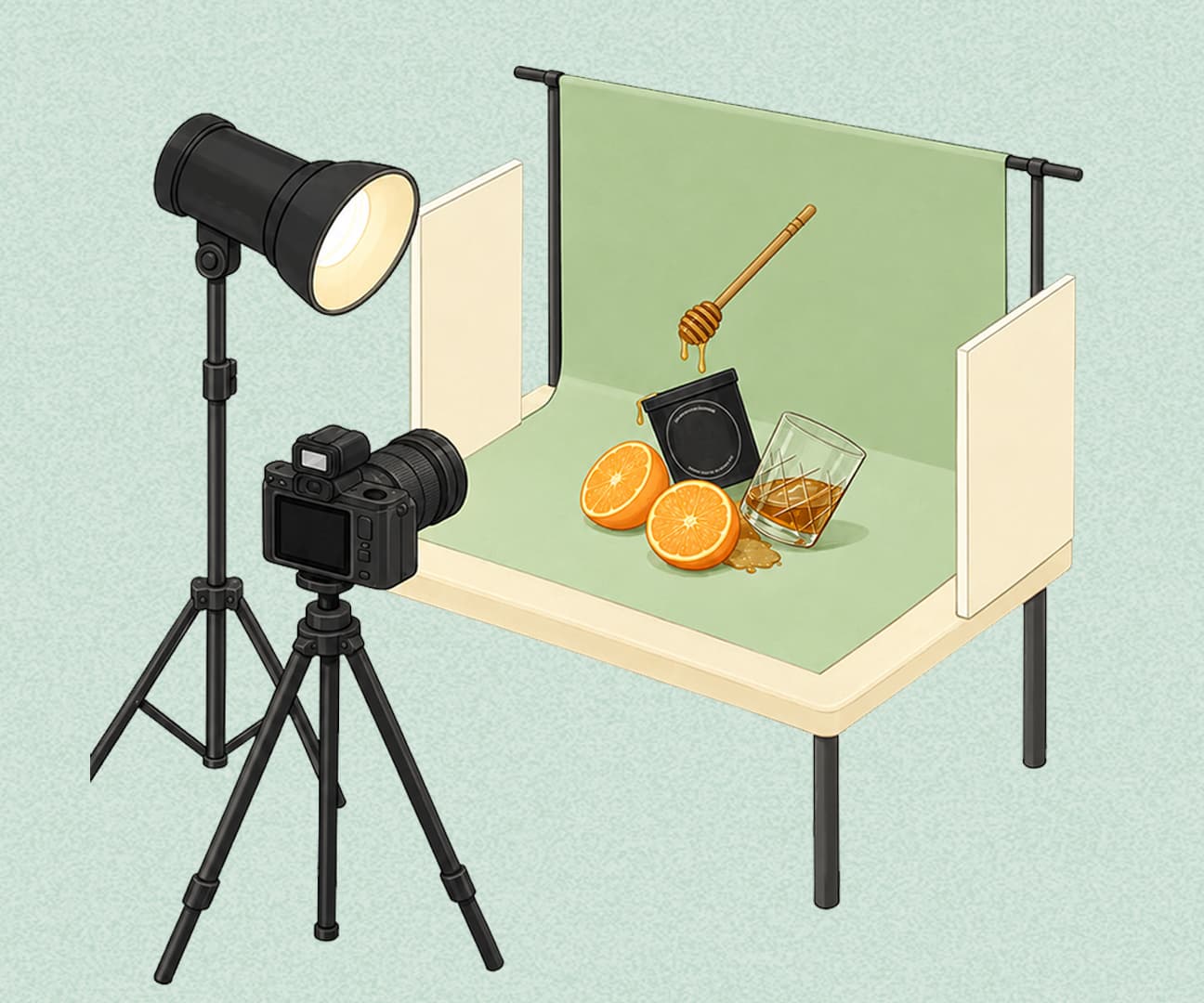
Coming from a background in fashion photography, moving into product photography felt like a fairly seamless transition. The fundamentals were familiar: light, angles, composition, texture and the ability to make something look a certain way through a lens.
But the more I worked with products, the more I realised there was one fundamental difference.
With a human subject, you have room to mould.
You can direct a model to change an expression, adjust a posture, shift an emotion or bring out a particular characteristic. A slight change in the eyes, a tilt of the head or a shift in body language can completely transform a frame.
With a product, it's different.
A product is what it is. Its shape, material, finish, proportions and physical characteristics are already defined. You can't ask a bottle to change its expression or tell a chair to give you a more interesting profile.
What you have is what the brand has made.
And that's where the real craft of product photography begins.
The Art of Moulding What You Can't Change
I've always thought of directing a human subject as being a little like pottery. You have something in front of you that you can shape, guide and mold until it becomes what you imagined.
Product photography is a different kind of challenge.
You don't necessarily get to change the object. Instead, you change how the object is perceived.
Lighting becomes your primary tool. Angles determine how the product reveals itself. Shadows can add depth, reflections can communicate quality, and the smallest shift in camera position can change the way a material feels.
A glossy surface can look premium or distracting. A transparent bottle can feel delicate or disappear into its background. A metallic finish can look rich and sophisticated, or flat and lifeless.
The product hasn't changed. Your interpretation of it has.
This is what makes product photography so interesting to me. You're working within a set of physical limitations, but the creative possibilities within those limitations are enormous.
And this way of thinking carries into advertising films, too. When a product is the hero of a film, every movement, reflection and camera angle has to be considered. You might have a beautiful product in front of the camera, but unless you know how to reveal it, you're only capturing what is already there.
With a human subject, you can mould the character. With a product, you have to find the character that's already there and use light, angles and composition to bring it out.
Before the Camera Clicks, the Thinking Has to Happen
In product photography, you can't always rely on improvisation once you're on set.
You need to anticipate what the camera will see before it sees it.
Where will the light fall? What will the surface reflect? Will the product's texture hold up in a close-up? Does the angle communicate the right proportions? Is the colour accurate? Will the packaging look as premium on screen as it does in person?
These aren't just technical questions. They're creative decisions.
This is where experience, observation and a trained eye become important. You start noticing things that might not be obvious at first glance — a reflection running across the wrong part of a bottle, a shadow hiding a product detail, or a highlight that makes a surface look cheaper than it actually is.
And often, the solution isn't a bigger setup or more equipment. It's a small adjustment that changes everything.
That's also why the PPM deck matters so much. References, lighting diagrams, angles, surfaces and visual treatments aren't just there to make a presentation look good. They help everyone understand what we're trying to achieve before we commit to executing it.
When directing an advertising film, this thinking expands beyond a single frame. You need to consider how the product will be introduced, how it will move through the story, how the lighting will remain consistent across shots and how individual frames will eventually come together in the edit.
The more clearly we can visualise the outcome beforehand, the more deliberately we can build it on set.
AI Can Visualise It. But Can It Understand What Matters?
AI has changed the way we approach visualisation, and I think that's a good thing.
Today, we can explore lighting directions, experiment with backgrounds, break down references and communicate visual ideas in ways that would have taken considerably more time earlier.
For product shoots, this can be especially useful during pre-production. We can explore different environments, understand how a product might sit within a particular visual world, and give clients a clearer picture of the intended outcome.
It can also be useful when developing advertising films. A director can use AI to explore a visual treatment, test the mood of a scene or communicate an idea that might otherwise be difficult to explain through words alone.
But there's another side to this.
Sometimes, the brief is straightforward. A brand needs clean e-commerce imagery, a consistent background and accurate product representation. In those cases, AI-generated backgrounds and lighting treatments can open up useful possibilities without requiring every visual element to be physically built on set.
The important thing is knowing when that approach makes sense.
A generated reference can help communicate an idea, but the actual product still needs to be represented correctly. Its shape, colour, finish, proportions and defining details matter, particularly when the image is meant to sell a real product.
And when we're working on a film, the challenge is bigger than generating one impressive frame. The visuals need to work together across multiple shots, with continuity, movement and a clear creative intention.
Technology can help us get closer to the image we're imagining.The job is to make sure that what we're creating remains faithful to the product and the brand.
The Human Eye Still Matters
AI has also made parts of the post-production process considerably easier. Retouching workflows, background generation, image extensions and certain corrections can now be explored much faster.
But I still believe human retouching is essential.
Not because every task needs to be done manually, but because knowing what to correct is just as important as knowing how to correct it.
A product image can be technically clean and still feel wrong. A reflection might be physically plausible but visually distracting. A surface might be perfectly smooth but lose the texture that makes it believable. A colour correction might make an image look beautiful while moving it away from the actual product.
These are the nuances that require judgement.
The aim of retouching isn't simply to make everything perfect. It's to make the image look the way it should, while preserving the qualities that make the product real.
The same principle applies to advertising films. A shot can be technically flawless, but if the product doesn't look right, the movement feels unnatural or the visual doesn't serve the story, something is missing.
AI can speed up the process, help us explore options and take care of repetitive tasks. But the final decisions still benefit from someone who understands the product, the lighting and the intention behind the frame.
AI can help create the image faster. A human eye helps decide whether it's the right image in the first place.
Has AI Taken Away the Need for Production?
Personally, I don't think AI has taken away the need for production. I think it has changed where production adds value.
If all you need is a generic visual, the distance between an idea and an image has become much shorter. But advertising rarely stops at generating an image.
There's a brief to interpret, a product to represent accurately, a brand identity to protect, a visual language to establish and a final output that has to work in the real world.
With product photography, this means understanding how to light, position and present the actual product. With advertising films, it also means understanding performance, camera movement, pacing and how individual shots contribute to the larger narrative.
A generated frame might look impressive on its own. But will it work as part of a sequence? Will the product remain consistent? Will the final film communicate the intended message?
These are the questions that still need to be answered.
AI might get you to an impressive first result. But the decisions made by a director, photographer, lighting team, art director, editor and retoucher can take that result much further.
I often think of it this way: AI can get you to 100% of an output, but the right people, the right process and the right creative judgement can make that output ten times more meaningful.
A Content Production Company Needs More Than Tools
This is also where I think the role of a content production company is evolving.
It's no longer enough to simply have the right cameras, lights, studio space or software. Those things are important, but they're tools.
The real value lies in understanding which tools to use, when to use them and what the final work needs to achieve.
Sometimes, the right answer is a carefully constructed physical set, precise lighting and a full production crew. Sometimes, it's a leaner e-commerce shoot supported by AI-generated backgrounds. Sometimes, it's a combination of real photography, AI-assisted workflows and detailed human retouching.
And when the brief is an advertising film, the solution might involve a combination of live-action performances, product beauty shots, carefully planned camera movements and AI-assisted post-production.
There isn't one approach that works for every brief.
The job is to understand the requirement, recognise the limitations and find the most effective way to deliver the intended result without compromising what matters.
At Ting Studios, this is the space I find particularly exciting — bringing production craft and emerging technology together, while keeping the creative intent at the centre of the process.
Because efficiency is valuable. But efficiency without judgement can only take you so far.
My Two Cents
A model can respond to direction. A product cannot. You have to understand its physical characteristics, discover what makes it interesting and use the tools at your disposal to bring that out.
Sometimes, the biggest creative challenge isn't moulding what you have. It's learning how to work with what you can't change.
For me, the future isn't about choosing between AI and human execution. It's about knowing how to bring the two together.
Because getting an output is one thing.
Knowing how to make it better is the craft.
about the author
Sumit Chavan
Associate Creative Director – Studios